
Trump Accounts: What Parents Need to Know
If you have young kids (or grandkids), you’ve probably heard at least something about the new “Trump Accounts.”
The headline is pretty appealing: the government may put $1,000 into an investment account for your child, and the money could compound for decades.
That part is real. But once you get beyond the free $1,000, the question gets more interesting:
Should you actually put your own money into one?
For most families, I don’t think the answer is automatically yes.
Trump Accounts have some genuinely useful features, and there may eventually be a really compelling Roth conversion opportunity. But they also come with restrictions and tax treatment that make other accounts—especially 529s, your own retirement accounts, and even taxable brokerage accounts—more attractive in many situations.
Here’s what I think parents actually need to know.
First: What is a Trump Account?
A Trump Account is a new investment account for children created under the One Big Beautiful Bill Act, signed into law on July 4, 2025.
Any child under age 18 with a valid Social Security number can have one.
For children born between January 1, 2025 and December 31, 2028, the federal government will contribute a one-time $1,000 seed deposit if the child is a U.S. citizen.
There is no income requirement for the family, and the child does not need earned income.
That last part is important.
Normally, you can’t open and fund an IRA for a child unless they actually have legitimate earned income. A Trump Account allows investing to begin essentially from birth.
Technically, the account is treated as a traditional IRA with a special set of rules during childhood. On January 1 of the year the child turns 18, those childhood restrictions end and the account begins operating like a regular traditional IRA.

Who gets the free $1,000?
A child must:
Be born between 1/1/2026 and 12/31/2028
Be a U.S. citizen
Have a valid Social Security number
The $1,000 government contribution does not count against the annual contribution limit.
There are also some additional programs being layered on top of the federal benefit.
The Michael and Susan Dell Foundation, for example, pledged funding for $250 deposits for qualifying children under age 10 who were born before 2025 and live in ZIP codes with median household incomes of $150,000 or less.
States, nonprofits and employers may also make contributions.
So even if your child isn’t eligible for the federal $1,000, it may still be worth checking whether another program applies.
How much can you contribute?
The annual contribution limit is currently $5,000 per child.
Unlike a Roth IRA, the child does not need earned income during the childhood growth period.
Parents, grandparents, other family members and friends can contribute.
Employers can also contribute up to $2,500, although that contribution counts toward the same $5,000 annual limit.
Government and certain charitable contributions are separate and do not count toward the $5,000 cap.
The annual limit is scheduled to begin adjusting for inflation in 2028.
One other useful feature: putting money into a Trump Account does not reduce what can be contributed to other retirement accounts.
A working teenager, for example, could potentially have both a Trump Account and a separate IRA.
How to open one
The process is relatively straightforward.
You can file IRS Form 4547 or use the government's Trump Account website.
You'll generally need your child's:
Social Security number
Date of birth
Address
For an eligible child born from 2025 through 2028, you also elect to receive the $1,000 federal seed contribution.
The short version (scroll past for more details)
If you’re a busy parent and only remember a few things from this article, I’d make them these:
Take the free money.
If your child qualifies for the $1,000 federal contribution—or another charitable contribution—I see very little reason to leave that on the table.
Don't assume you need to max the account.
An additional dollar going into a Trump Account is competing with a dollar that could go into your retirement plan, a 529 or a flexible investment account.
Those alternatives may be more valuable depending on your family's goals.
The Roth conversion opportunity is worth remembering.
For kids who eventually accumulate meaningful Trump Account balances, their early adult years may create a valuable opportunity to convert traditional IRA dollars into Roth dollars while their tax rate is unusually low.
That's the part I’ll be watching most closely.
And perhaps the larger lesson here is the same one that applies to almost every new financial account Congress creates:
The account itself isn't the strategy.
The important question is what you're trying to accomplish for your family, what other tools are available, and where this particular account actually fits.
For some families, Trump Accounts may become a meaningful part of building generational wealth.
For others, claiming the free contribution and putting the rest of their money elsewhere may be the better move.
Both can be perfectly reasonable decisions.
There’s one tax concept you really need to understand: basis
This is probably the least exciting section of this article, but it matters.
Money you personally contribute to the account is generally contributed with dollars you’ve already paid taxes on.
Those private contributions create what tax professionals call basis.
That means you don’t pay income tax on those dollars again when they eventually come back out of the account.
The government’s $1,000 contribution is different.
You never paid tax on that money, so it does not create basis.
The same generally applies to employer and charitable contributions.
Investment growth is also taxable when it eventually comes out.
For example, imagine that over many years:
Your family contributes $5,000.
The government contributes $1,000.
The account eventually grows to $40,000.
Your $5,000 of family contributions represents basis.
The rest of the account—the government contribution plus investment growth—will generally be taxable as ordinary income when distributed or converted.
That tax treatment becomes particularly important once we start talking about Roth conversions later.
How is the money invested?
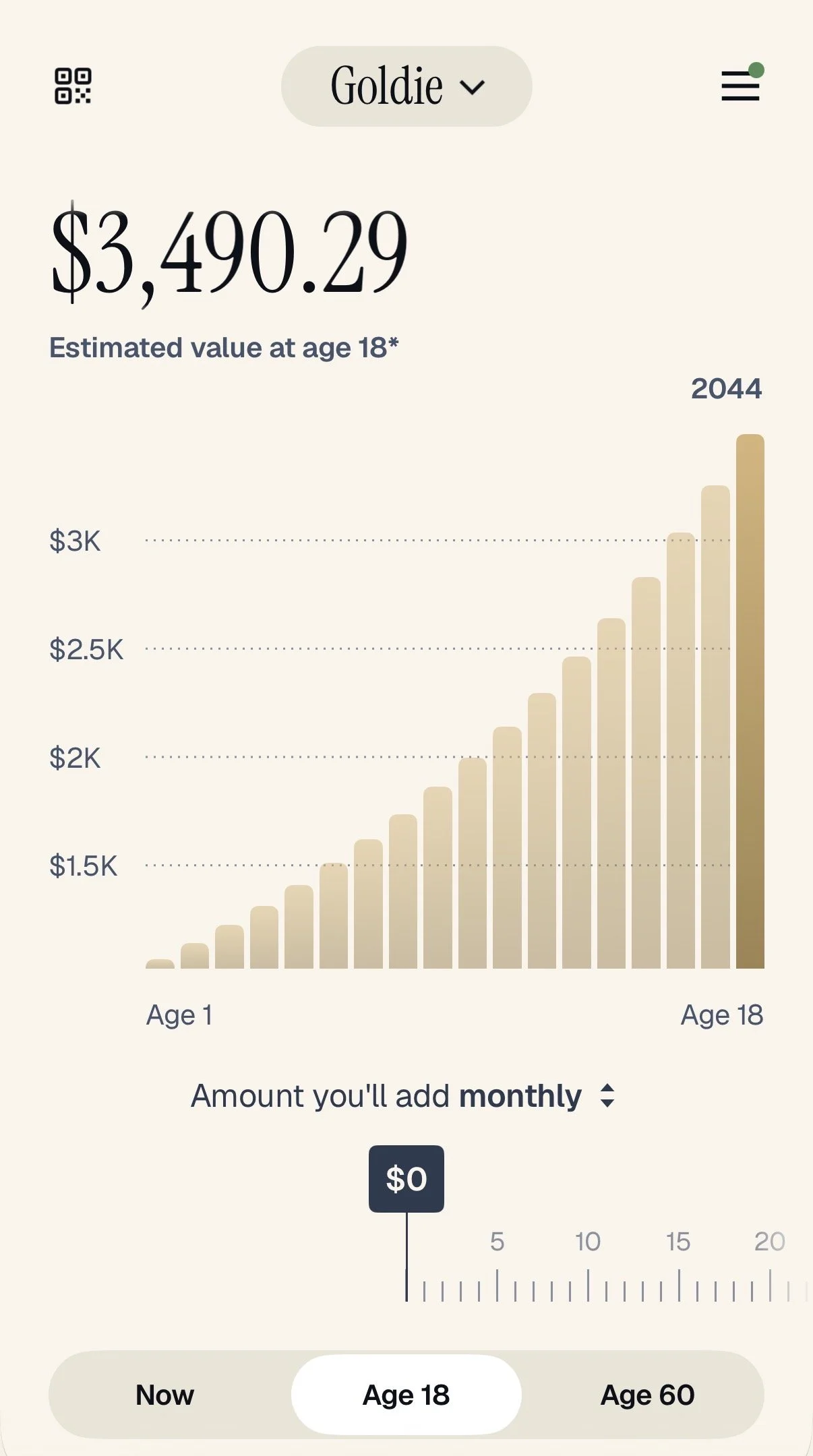
During childhood, your investment choices are pretty boring, and that's a good thing.
As of this writing, I cannot see a way to NOT have the money invested in "SPYM" (an S&P 500 index fund). The $1,000 we received in the account for our daughter were automatically invested into this fund.
The money is basically locked up during childhood
Before age 18, withdrawals generally aren’t allowed.
There are limited exceptions for things like correcting excess contributions, certain rollovers or the beneficiary’s death, but this is not an account you should fund with money your child may need at age 12.
Investment earnings grow tax-deferred while the money remains inside the account.
A parent or authorized adult manages the account during childhood.
Then, on January 1 of the calendar year the child turns 18, the account transitions into a traditional IRA.
Notice that I said January 1—not the child’s birthday.
A child turning 18 in December enters the traditional IRA phase at the beginning of that calendar year.
What changes at 18?
Quite a bit. The young adult gets control of the account. The childhood investment restrictions disappear.
Withdrawals become possible, although traditional IRA taxes and potentially the 10% early-withdrawal penalty can apply.
Standard IRA exceptions may also apply, including certain qualified higher-education expenses and qualifying first-home purchases.
Most importantly for planning purposes:
The account can now be converted to a Roth IRA.
I think this may eventually prove to be one of the more interesting features of Trump Accounts.
More on that in a minute.
Trump Account vs. 529 vs. Roth IRA vs. brokerage account
This is where I think a lot of the early excitement around Trump Accounts needs some context.
There is no universally “best” account for your child.
They solve different problems.
Trump Account
Best suited for very long-term wealth building.
Advantages:
No earned income required during childhood
Potential free government or charitable contributions
Decades of tax-deferred compounding
Low-cost investments
Potential Roth conversion opportunities later
Tradeoffs:
Money is locked up during childhood
Investment choices are limited
Growth is eventually taxable as ordinary income unless converted
Private contributions receive no federal income-tax deduction
529 plan
In my opinion, the absolute best tool available to parents when funding education.
Money grows tax-free and qualified education withdrawals are tax-free. Depending on where you live, contributions may also qualify for a state income-tax benefit (both KS and MO have this)
For families who reasonably expect to help pay for college, trade school or other qualifying education expenses, that combination is hard to ignore.
Custodial Roth IRA
If your child has legitimate earned income, this is incredibly powerful.
You contribute after-tax dollars today, the investments can compound for decades, and qualified withdrawals can eventually be completely tax-free.
The catch is that your child actually needs earned income. But they don't have to use THAT earned income to fund it. You could gift them the money to fund it, and they can use their income to "go see a Star War" (iykyk).
Taxable brokerage account
There’s no special tax shelter here, but taxable accounts offer something I think people routinely undervalue:
flexibility.
There are no retirement-account withdrawal restrictions. You have broad investment choices. And the money can eventually be used for a house, business, travel, early retirement or whatever life brings.
That flexibility has real financial-planning value.
So what am I personally doing?
My daughter qualifies for a Trump Account, and we've claimed the free $1,000.
But I am not currently planning to make additional family contributions to her Trump Account.
And for most of my clients, I’m thinking about these accounts the same way.
There are several things I would generally prioritize first.
1. Make sure your own retirement is on track
This comes first.
Your 401(k), IRA, Roth IRA and other retirement savings may provide tax benefits, employer matching and decades of compounding.
Funding your child’s future while neglecting your own retirement will not improve the family’s overall financial picture.
2. Build the 529 appropriately
If helping with education is a goal, I would generally want the 529 strategy in good shape before funding a Trump Account.
The potential for tax-free growth and tax-free qualified education withdrawals is powerful.
And depending on your state, you may receive an immediate state income-tax benefit for contributing.
Don't forget that 529 Plans also allow for rollovers to Roth IRAs now (current max is $35k).
3. Don't underestimate the taxable brokerage account
I also like for families to have meaningful assets that aren’t attached to retirement or education rules.
A taxable brokerage account can become the money that helps a child buy their first home, start a company, take a sabbatical, move across the country or navigate something none of us can predict today.
That flexibility is valuable.
4. Then... consider additional Trump Account contributions
Once those other areas are in a strong position, I think Trump Accounts become more interesting as a long-term generational wealth tool.
This doesn’t make them bad accounts.
It just means the free $1,000 and the decision to contribute another $5,000 every year are two very different decisions.
I would absolutely evaluate them separately.
The part I'm most interested in: Roth conversions
This is where the planning gets much more interesting.
Once the Trump Account becomes a traditional IRA, the young adult can convert some or all of it into a Roth IRA.
A Roth conversion means paying income tax today on the taxable portion of the conversion.
In exchange, the converted money can then potentially grow inside the Roth for decades and ultimately be withdrawn tax-free if Roth requirements are met.
Imagine converting money when your child is 22 instead of withdrawing it when they’re 70.
That creates a potentially enormous planning window.
What actually gets taxed during the conversion?
Not necessarily the entire account.
Remember basis?
Private contributions from parents, grandparents and family were generally made using after-tax money. Those contributions create basis.
The taxable portion generally includes:
Investment earnings
The $1,000 federal contribution
Employer contributions
Charitable contributions
Growth attributable to those dollars
That distinction can matter a lot if the account becomes large.
Why the young-adult years could be valuable
Many people have one unusually low-income period during their adult lives:
the years right after high school or college.
A 21-year-old earning $25,000 may be in a dramatically lower tax bracket than that same person at 40.
So instead of leaving a large traditional IRA untouched for decades, there may be an opportunity to gradually convert it to Roth while the child is still in a relatively low tax bracket.
Suppose a Trump Account reaches roughly $110,000.
Of that:
$60,000 represents private family contributions and basis
$50,000 represents taxable investment growth and other non-basis dollars
If the account is converted, the $60,000 of basis isn't taxed again.
The $50,000 taxable portion is included as ordinary income.
If that income could legitimately be converted while the young adult is in a very low marginal tax bracket, you may be able to move a substantial amount into a Roth at a relatively modest tax cost.
That Roth could then potentially compound for another 40, 50 or even 60 years.
That’s the opportunity.
But there are several ways to screw it up.
The big Roth conversion traps
Kiddie tax
This is probably the biggest one.
If the child is under 19—or under 24 and a full-time student who remains dependent on their parents—certain unearned income above the applicable threshold may be subject to the parents’ marginal tax rate.
A Roth conversion can create taxable income.
So simply saying, “My 19-year-old has almost no income, let's convert the entire account at 10%,” may not work the way you expect.
For some families, the cleaner opportunity may come once the child is independent, out of school and no longer subject to kiddie-tax rules.
Paying the tax
Ideally, you don't want to use retirement-account money to pay the tax generated by the conversion.
If part of the IRA has to be distributed to cover taxes, that withdrawal itself may create additional taxes and potentially an early-distribution penalty.
Outside cash to pay the conversion tax can make the strategy significantly more attractive.
The Roth five-year rules
Roth conversions come with five-year holding-period rules that need to be considered before converted dollars are withdrawn.
This probably isn't a major concern if the plan is to leave the money invested for decades.
But it matters if the young adult expects to access the converted money relatively quickly.
FAFSA and financial aid
Roth conversion income may also affect financial-aid calculations.
So college may look like the obvious low-income conversion window from a tax perspective while simultaneously being a terrible year to create a large amount of income for financial-aid purposes.
This is exactly why I would treat the conversion as a planning exercise rather than a one-time transaction.
Sometimes the best answer may be converting the account gradually over several years.
If you have questions, please reach out. We're here to help.
This article is intended for general educational and informational purposes only and does not constitute tax, legal or investment advice. Trump Account rules and IRS guidance may continue to evolve. Consult your financial advisor and tax professional before making decisions based on this information. Examples are hypothetical and do not guarantee future investment results. Investing involves risk, including the possible loss of principal.